Only into cells that fit
We only connect contact and deformable-part assembly cells that pass the three axes (inference margin, difficulty of alternatives, standards maturity) — stopping failure stories about your robot in cells that never fit.
Robot makers
BlueRoboWorks makes no robots. We put other people's robots to work — in contact and deformable assembly cells where part numbers change often.
In a country already dense with robots, the open question is not “how many more” but “how many more jobs can each one do.”
We have no official partnerships yet. Right now we exchange technical information and look for pilot cells together.
§01Working with us
The questions after the sale — does it work in this cell, what happens when the part number changes, what goes to the safety team — answered with cell data.
We only connect contact and deformable-part assembly cells that pass the three axes (inference margin, difficulty of alternatives, standards maturity) — stopping failure stories about your robot in cells that never fit.
We do the work of mapping your SDK to common observation, action and guarantee interfaces. π0.5, GR00T and SmolVLA policies run through the same adapter.
ISO 10218-2:2025 brings the robot program into the unit of assessment. Every behavior change leaves a regression report and an evidence pack that answer your customer's quality and safety teams.
Source · F-019 (B+)
Task goals, completion checks and tuning are stored in task coordinates, not robot joint values — so the same task follows when you move from single-arm to dual-arm.
§02What we look for
Korean shop floors already run many robots, change part numbers often and keep their plant networks isolated. Our first market is contact and deformation assembly, not inspection — parts that bend, like cables, gaskets and connectors, and processes that need force, like fastening and press-fit. What is needed is a robot that works on existing benches and jigs and is re-matched every time the part number changes. Model training runs in our own training stack, so what manufacturers need to provide is how to record data accurately through your SDK, and how to execute policy actions safely and predictably.
The form with the most mature certification and SDKs. The differences show up in servo rate, force/impedance control and command-port security.
What we ask first
Working while parked with brakes on, it can run close to a fixed cell. Base stopping-position repeatability sets the floor for assembly accuracy.
What we ask first
The applicable safety standard (ISO/CD 25785-1) is still a committee draft. The locomotion and balance controller is yours; we do not enter that loop.
What we ask first
A form’s track is set not by its technology but by whether a standard exists that can accept the evidence.
§03Partner profile
A best-selling robot is not necessarily a good robot to fine-tune. We look at whether control is open, and whether answers come as documents, specifications and change records rather than talk. For each form we send the same request to several manufacturers and lay the answers side by side on the six axes below — without adding up a score.
An external policy can use low-level and streaming commands, and the minimum period, jitter and timeout are documented. Policies issue commands at 15–50 Hz within an action chunk.
A table tells us whether a command is absolute or delta, in which frame, and whether out-of-limit commands are clipped or rejected. What an action means in training must equal what it means in execution.
Every function works without internet access or app login. Each outbound communication can be switched off, and the customer controls any remote-access path.
Deploying policies fine-tuned from π0.5 or GR00T, or trained with LeRobot, to your hardware is not restricted by your terms of use, license or warranty.
Certificate IDs, safety-function performance levels (PL/SIL), inputs for external e-stop and safety PLC. If there are none, say so in writing — a claim is not a certificate.
You confirm the hardware revision of each delivered unit and notify us before changes or discontinuation. Cells run for years.
“Not available” and “not supported” are valid answers. Telling us a box is empty beats filling it with a guess.
§04Technical requests
The common request for information (RFI) has ten areas. Every manufacturer gets the same questions, plus items for its form (fixed arm · wheeled dual-arm · biped). Each item says when we need it.
P0before purchase orderP1before data collection startsP2before safety sign-off and deployment
Five things we confirm in documents first
If any of these five is “not possible” and cannot be covered another way, we hold off on that form.
We write the robot adapter. It maps your SDK onto a common format of observation, action and guarantees. Following the LeRobot Robot convention (get_observation · send_action), π0.5, GR00T and SmolVLA policies run through the same adapter.
What a person signs at 06 GATE is not a policy alone but the combination of policy + adapter version + firmware version.
§05What we can do together
Only what we can actually do at this stage — connect, verify, and keep it as task assets.
01Adapter
An adapter on your SDK
W.01 · W.0502Real vs sim
Measured by the gap between real and sim
W.02 · W.0303Task assets
So the work outlasts the form
W.04We build the robot adapter for your SDK. Official integration examples (LeRobot driver · openpi config · GR00T embodiment config) shorten the work; without them, we build it ourselves.
When a sample arrives we measure version freeze, traffic, latency and sync, loss of communication, streaming period, action-semantics replay and chunk boundaries ourselves. A manufacturer’s answer is an input, not a verified value — demo collection starts only after action-semantics replay passes.
From your authoritative URDF/MJCF we set up the cell in CELLWRIGHT TWIN and measure the sim-to-real gap against paired real cycles. Simulation finds failure conditions; the real robot decides.
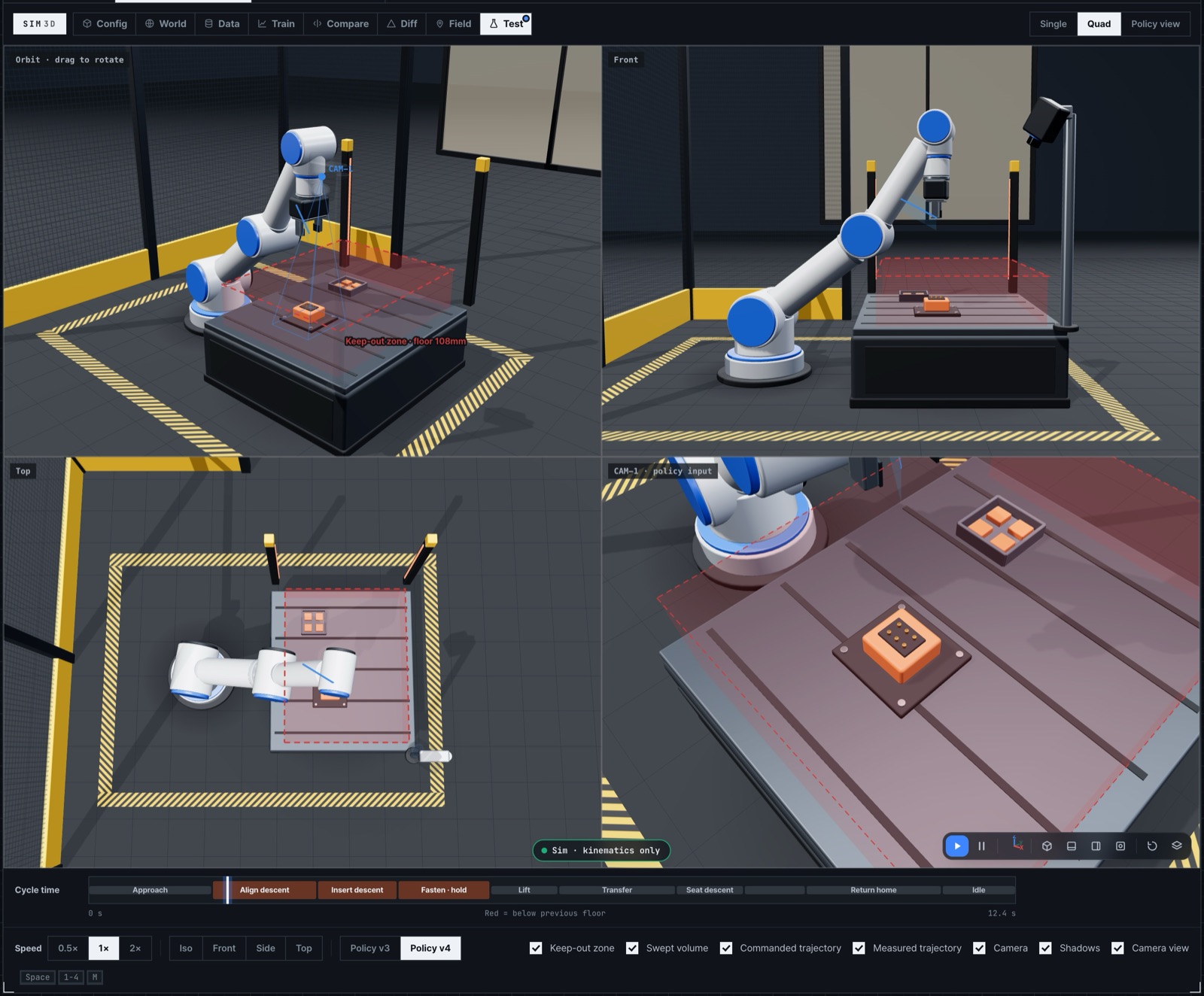 The console the adapter plugs into — open TWIN in quad view
Parts, jigs, completion checks and failure recovery are stored in part, jig and cell coordinates, not robot joint values. When you extend your line-up to dual-arm or humanoid forms, the same task carries over.
We are happy to sign an NDA. Before one is signed, we start with the P0 items that can be answered without it.
§06Lines we keep
§07How it goes
The same common RFI for each form. P0 items first, before any NDA.
Answers side by side on the six axes; candidates narrowed per form.
After the NDA: robot configuration, action-semantics table, streaming spec → adapter design fixed.
Demo collection starts once action-semantics replay passes.
Contract terms and cell installation conditions (network isolation · radios off) are fixed.
RFI · KO · EN · 中文To receive the RFI, use the form below — tell us the form factor and we add the matching items.
§08Contact
✓Inquiry summary
Send it from your mail app, or copy it into a message. The person in charge will reply.
Contact address pending — copy or save only for now
Could not send. Please send the text below from your mail app, or copy it to hello@axeworks.xyz.