Fits the spec, fails in the cell
Reach and payload can match, yet teaching pinned to coordinates breaks every time in a cell where parts deform and lighting shifts.
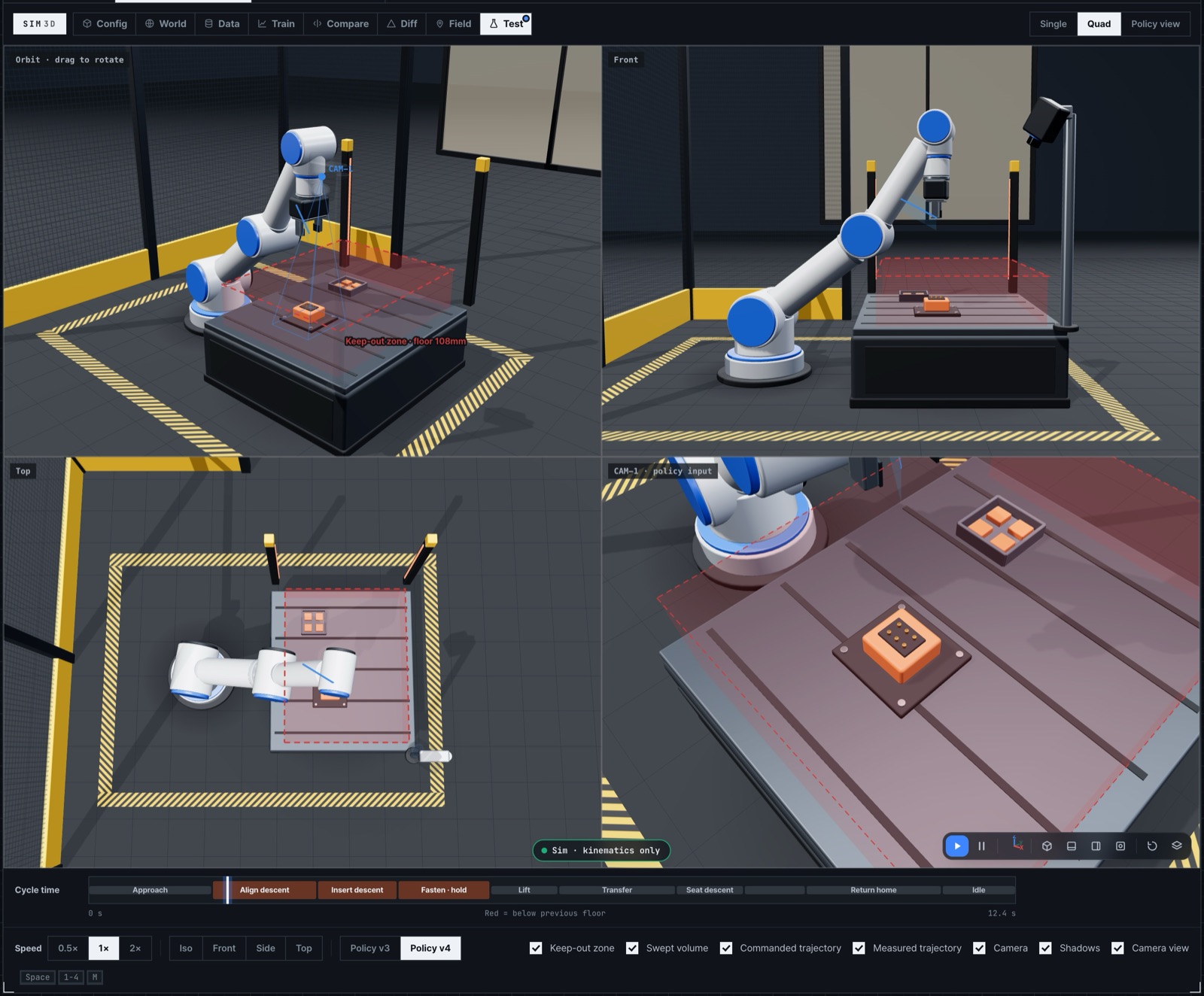
FIG.01 — Floor requirements × robot capabilities · conceptsrc · sim · 1×
[ ]Robot × floor matching
Seeking pilot cells · M0
We put robots to work.
Matching robots to the floor — every change, with data and evidence.
BlueRoboWorks makes no robots and brokers no vendors. We match robots to the floor with data. A forward deployed engineer (FDE) measures the cell and turns it into data, our own simulation platform checks the fit before a robot is installed, and Learning_deck trains the robot for that cell alone.
Concept diagram comparing five pairs of floor requirements and robot capabilities in 3D. Kinematic simulation, not measurement.
§01Problem
Korea has the highest manufacturing robot density in the world. Yet in assembly cells where part numbers change often and parts deform, robot and shop floor don't mesh. Unless the robot is matched with that cell's own data, it is there but can't do the work.
Reach and payload can match, yet teaching pinned to coordinates breaks every time in a cell where parts deform and lighting shifts.
Most of the deployment cost is setup and re-teaching, not the robot itself. It comes back every time the part number changes.
After teaching a new part number, did the ones that ran well get worse? What changed under the safety standard? Today, no one can prove it.
ISO 10218-2:2025 includes the robot program in the unit of conformity assessment. Behavior is the language of the standard.
Sources — IFR robot density release (2026.04) · BCG, How Physical AI Is Reshaping Robotics Today (2026.04) · ISO 10218-2:2025
§02Matching
Matching without data isn't matching. Catalogs and site visits can't make the fit — we fit with the cell's data, preview it in simulation, train on demonstrations from the floor, and close with evidence.
The site, as data
See the fit first
Train it to fit
EVIDENCEEvidence of fit — policy + regression report + evidence pack
Human checkLOOPRefit every time the part number changes — incidents return to training only after a human confirms
§03Technology
Turn the site into data, fit the robot before it's installed, and train it for that cell alone. All three run on one dataset — what's learned on the floor stays in the platform.
[ 01 · FDE ]
Forward Deployed Engineering
Matching starts with measurement.
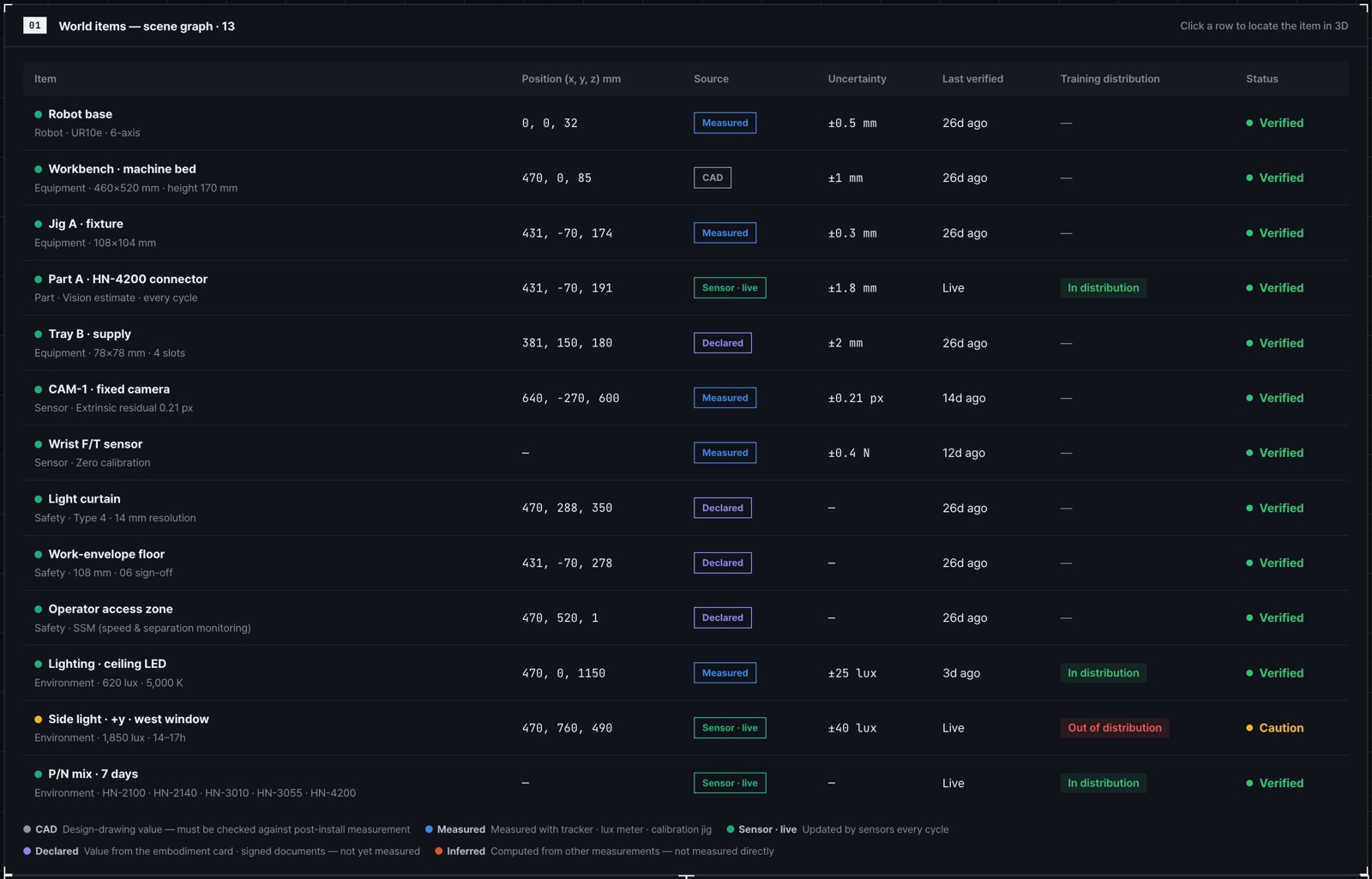
The FDE goes into the cell, measures the robot base, jigs, cameras and safety configuration, separates CAD, measured, sensor and declared values, and carries them into the embodiment card and world model. The three-axis fit check happens here first — if the cell doesn't fit, we stop here. What an FDE leaves behind is data, not an installation.
OUTPUTEmbodimentCard · WorldModel
[ 02 · SIMULATION ]
CELLWRIGHT TWIN
See whether it fits — before the robot is installed.
In a full-scale twin of the cell, reach margin is measured along the entire path, not at one point on the part. We run a 40-cycle perturbation campaign that shakes position, height, tool offset and speed, and leave anything outside the demonstration distribution as held. The twin is kinematics — contact success, lighting and occlusion are judged in the real cell.
OUTPUTRehearsalPlan · campaign verdict
[ 03 · LEARNING_DECK ]
Learning_deck
Baked overnight, for that cell alone.
Floor demonstrations are curated automatically, mixed with the replay corpus of existing part numbers, and used to LoRA-fine-tune an open robot foundation model. It starts at 22:00 and finishes before 07:00; the regression screen sends bad candidates back first. How many demonstrations a cell needs and how much replay to mix are measured per cell in the pilot.
OUTPUTPolicyArtifact · RegressionReport
§04Matching flow · 7 stages
But a cheap gate only filters. The verdict comes from real cycles.
Three-axis fit check and embodiment card. If the cell doesn't fit, it stops here.
RBERT does itOn-site demonstrations · 4-axis coverage · replay planning.
RBERT does itAuto-curation · failure/intervention labeling · dataset hash.
RBERT does itLoRA fine-tuning of the base RFM. Overnight, 22:00 → 07:00.
RBERT does itRegression screen → holdout → virtual rehearsal → air cut → 40 slow real cycles. Here it can only reject.
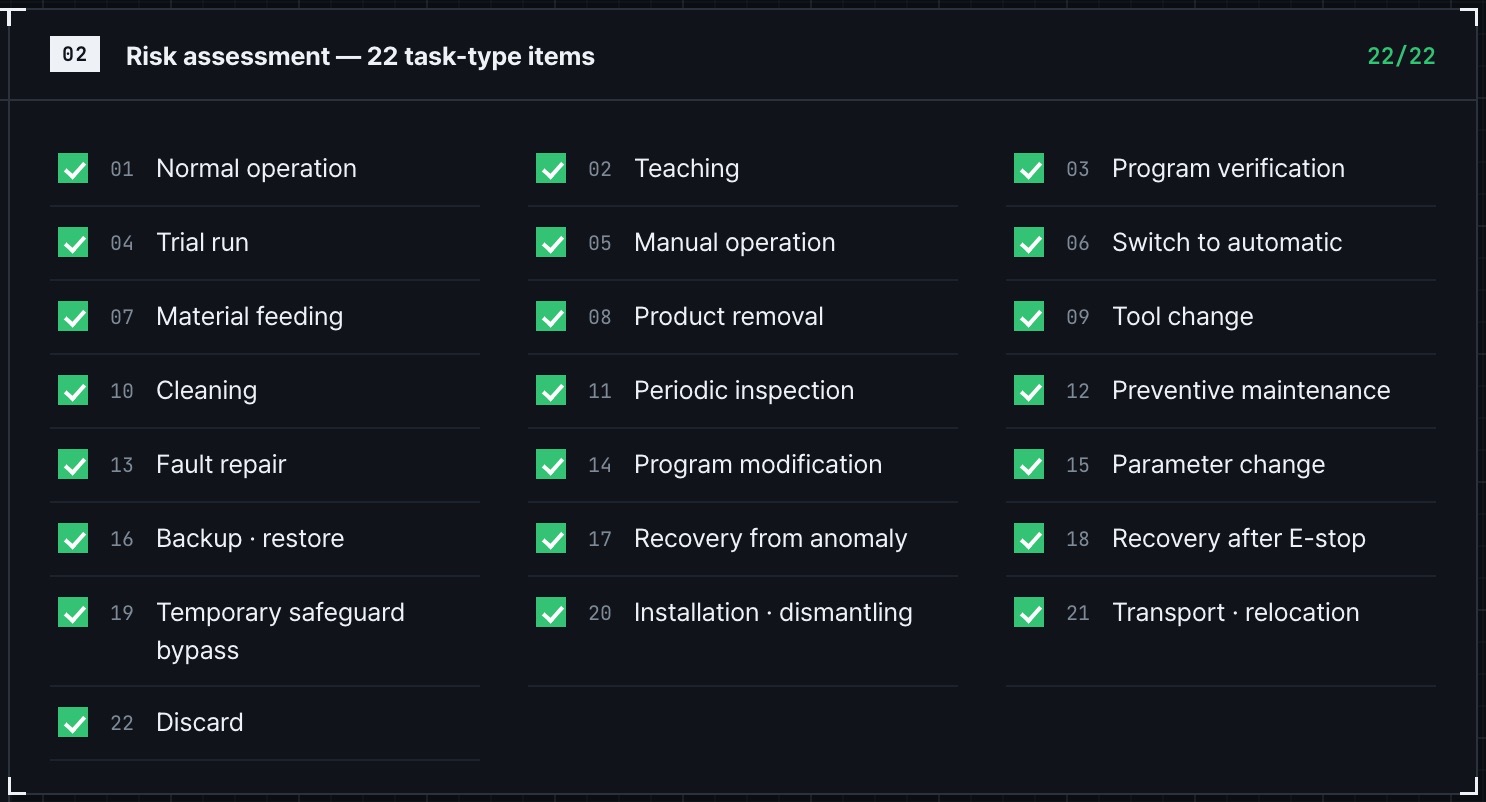
RBERT does itRisk assessment delta · 22 items · sequential-test bounds pre-registered · signature.
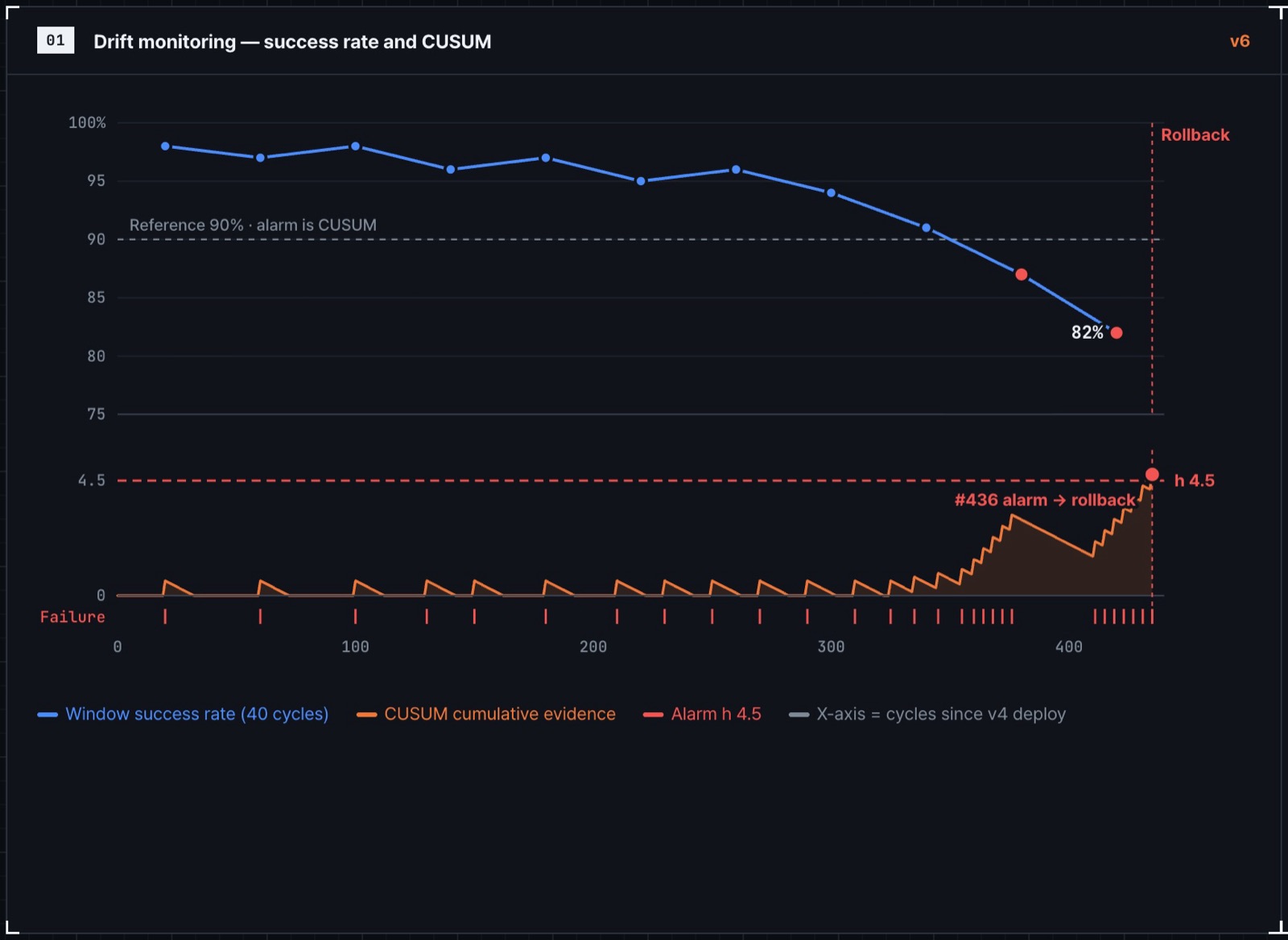
Only a human pressesShadow → canary → full rollout. On a drift alarm, automatic rollback within one cycle.
RBERT does itDesign · rehearsal · live. The 3D workbench above every stage.
RBERT does it§05CELLWRIGHT simulation
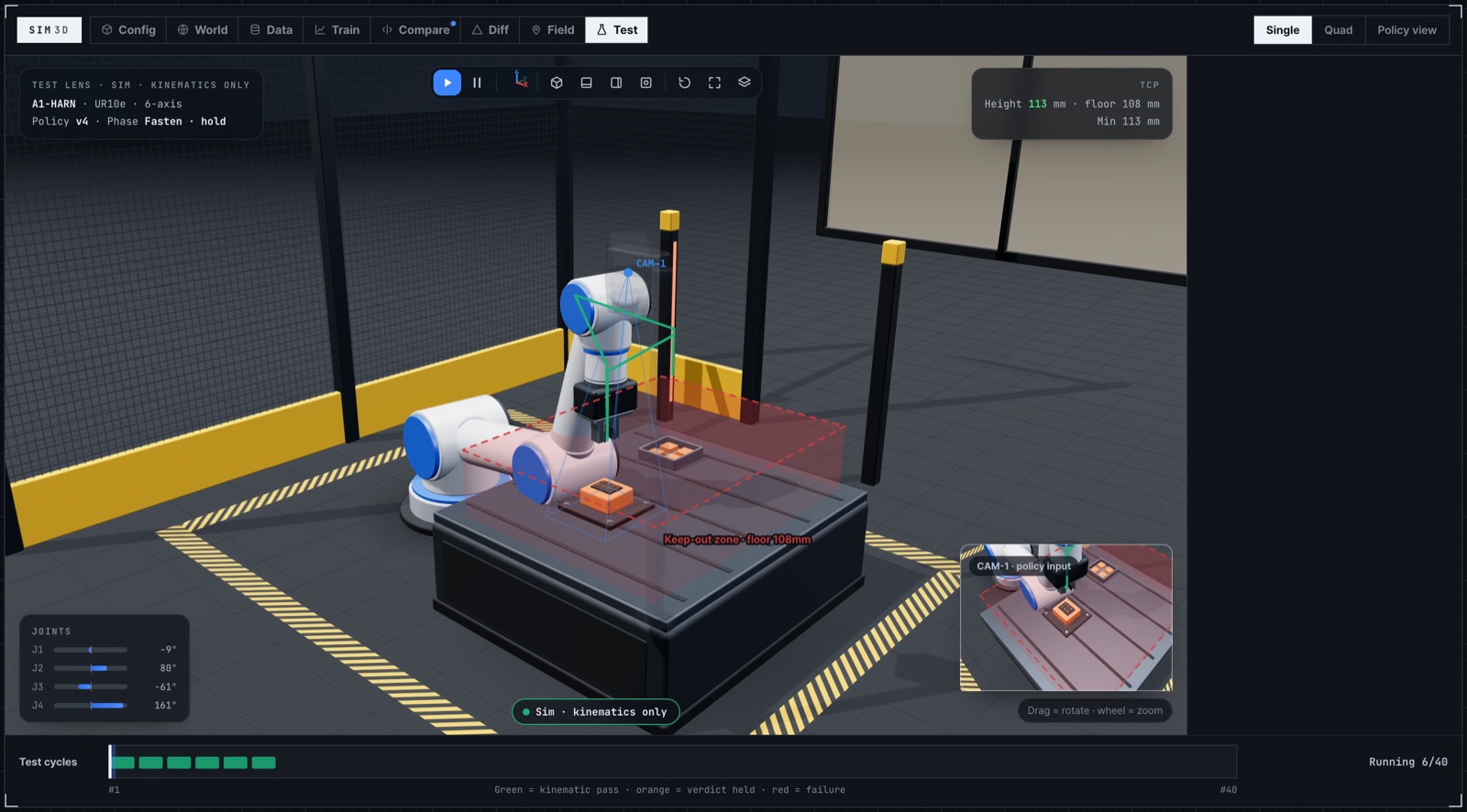
In a full-scale twin of the cell, RBERT runs the physical AI policy's movement, perturbs it, and overlays it on the previous policy. Instructions in plain words start a rehearsal; the real robot moves only after a person signs. Below are working prototype screens — click one and the scene opens in your browser.
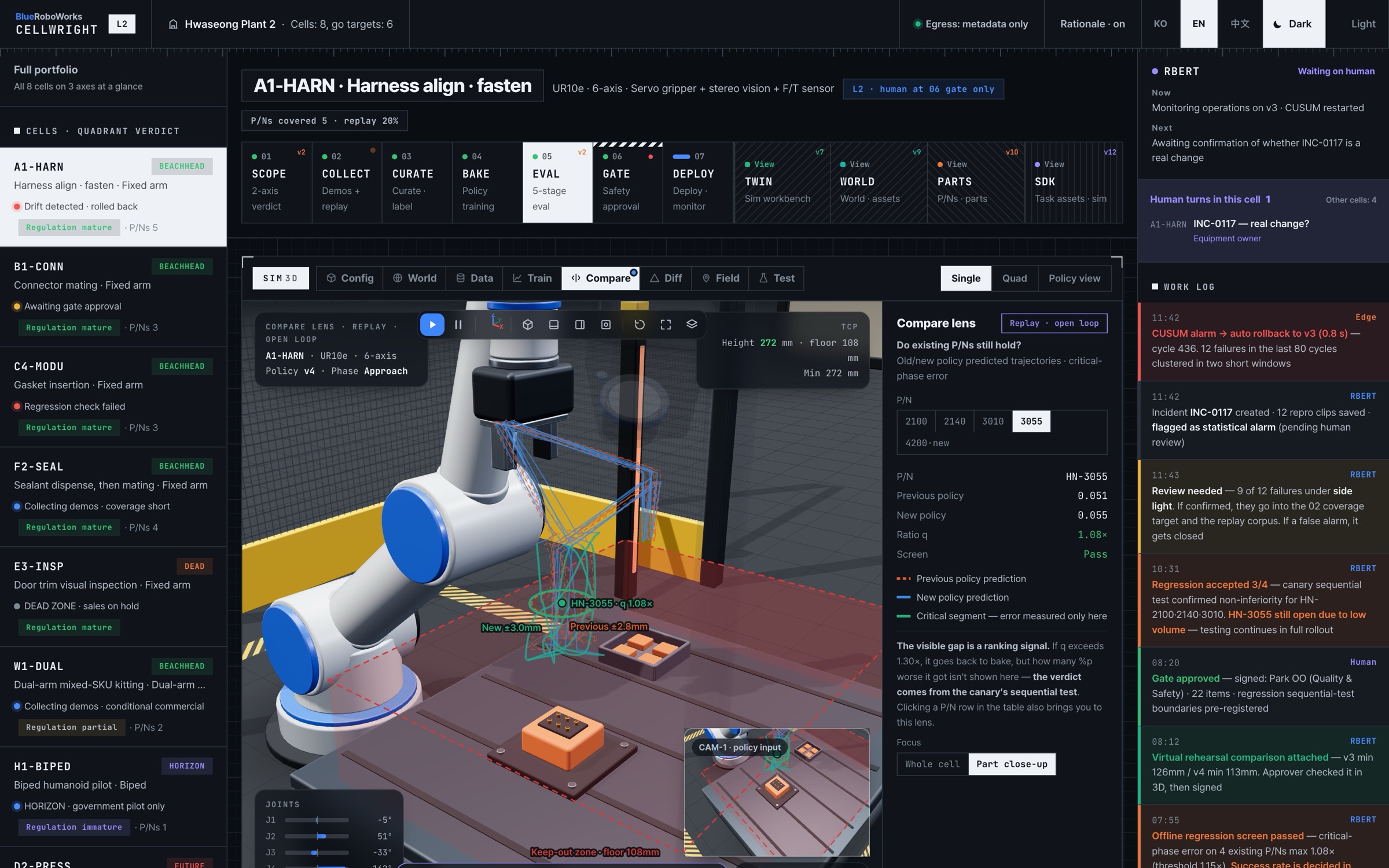 17 steps — simulation runs alongside each one; only 06 GATE is pressed by a person28 lenses — one scene seen as setup · world · data · training · compare · change · measured · test33D simulation — robot paths predicted by the previous and new policies, overlaid4Screen ratio q per part number — a ranking signal, not a success rate5RBERT's work log — rehearsals the AI ran · the human queue6Cell list — a twin fitted to each site7Source badge — always shows whether it is simulated or measured
Open the live simulation
prototypePrototype screens. The numbers come from the mockup scenario (eight cells such as A1-HARN), not from measurement.
§06Evidence
Not one file but three — policy · regression report · evidence pack.
A signed artifact fine-tuned for that cell and that part number. An unsigned policy is rejected at the edge.
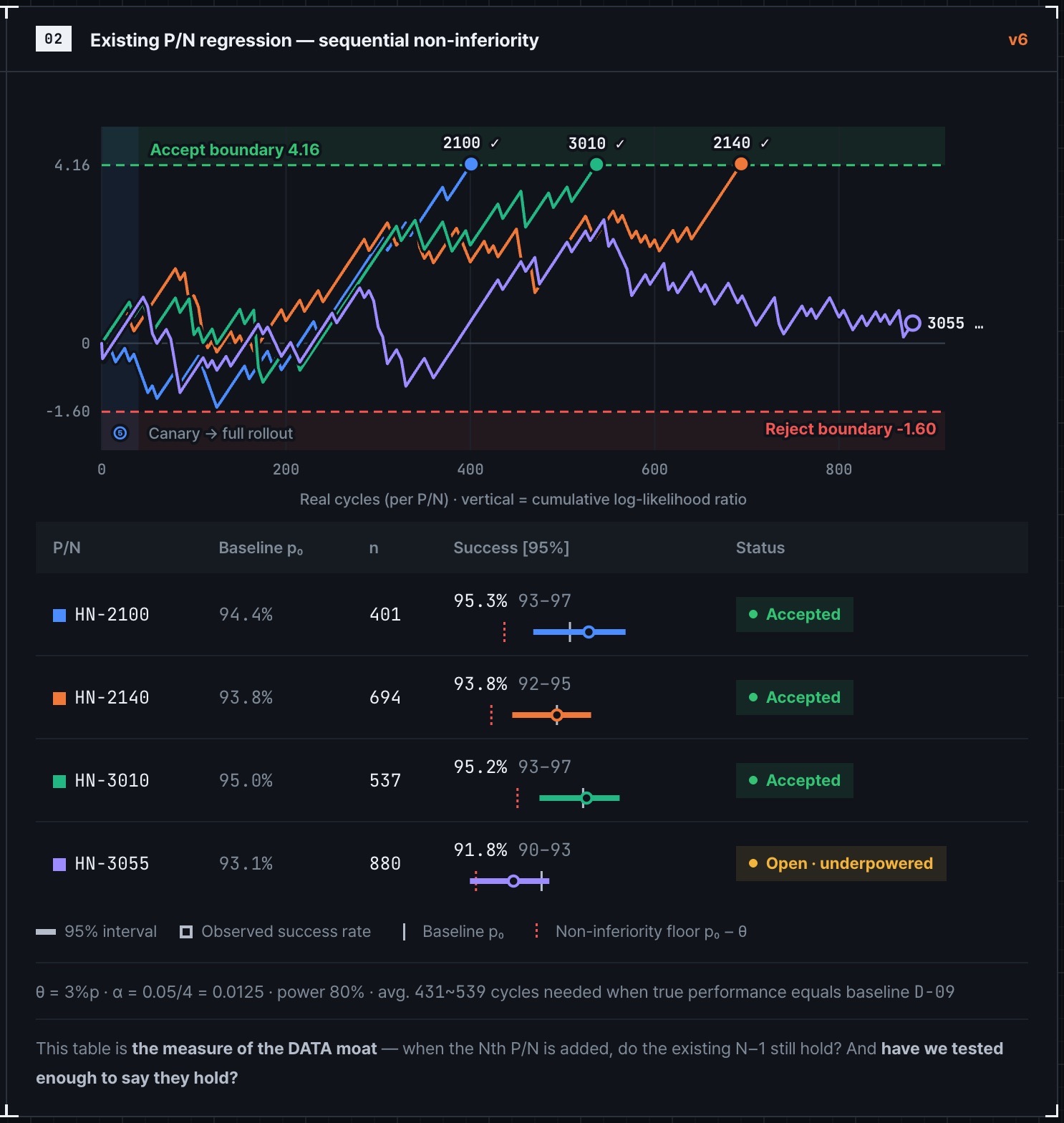
Screens out bad candidates first, using the new/old ratio of behavior error in the critical segments of existing part numbers. Acceptance and rejection come from the canary's sequential test.
Risk assessment delta · 22 items · changed parameters · pre-registered decision bounds · signature. It answers “what changed?” in front of the standard.
Log replay gives only open-loop error — a ranking signal, not a success rate. Acceptance and rejection come from the sequential test on the real canary.
θ · α · β · A · B are fixed at 06 GATE. Changing them mid-canary invalidates the test.
A layer without provenance isn't drawn. The badge can't be turned off.
So a simulation pass never lets anyone skip the air cut and the slow real cycles.
5 provenances
§07Boundaries
We stay out of balance and locomotion control and out of safety-function loops. Safety functions stay with the existing safety configuration.
People sign at 06 and confirm incidents. RBERT bakes, rehearses and monitors.
Natural-language instructions go through a rule-based interpreter to rehearsal only. A signature drives the real robot.
The export boundary is a condition of sale. Only opted-in metadata crosses it.
Stays
Crosses · opt-in
Raw dataDe-identified metadataExport boundary · conceptsrc · sim · 1×
§08Fit check
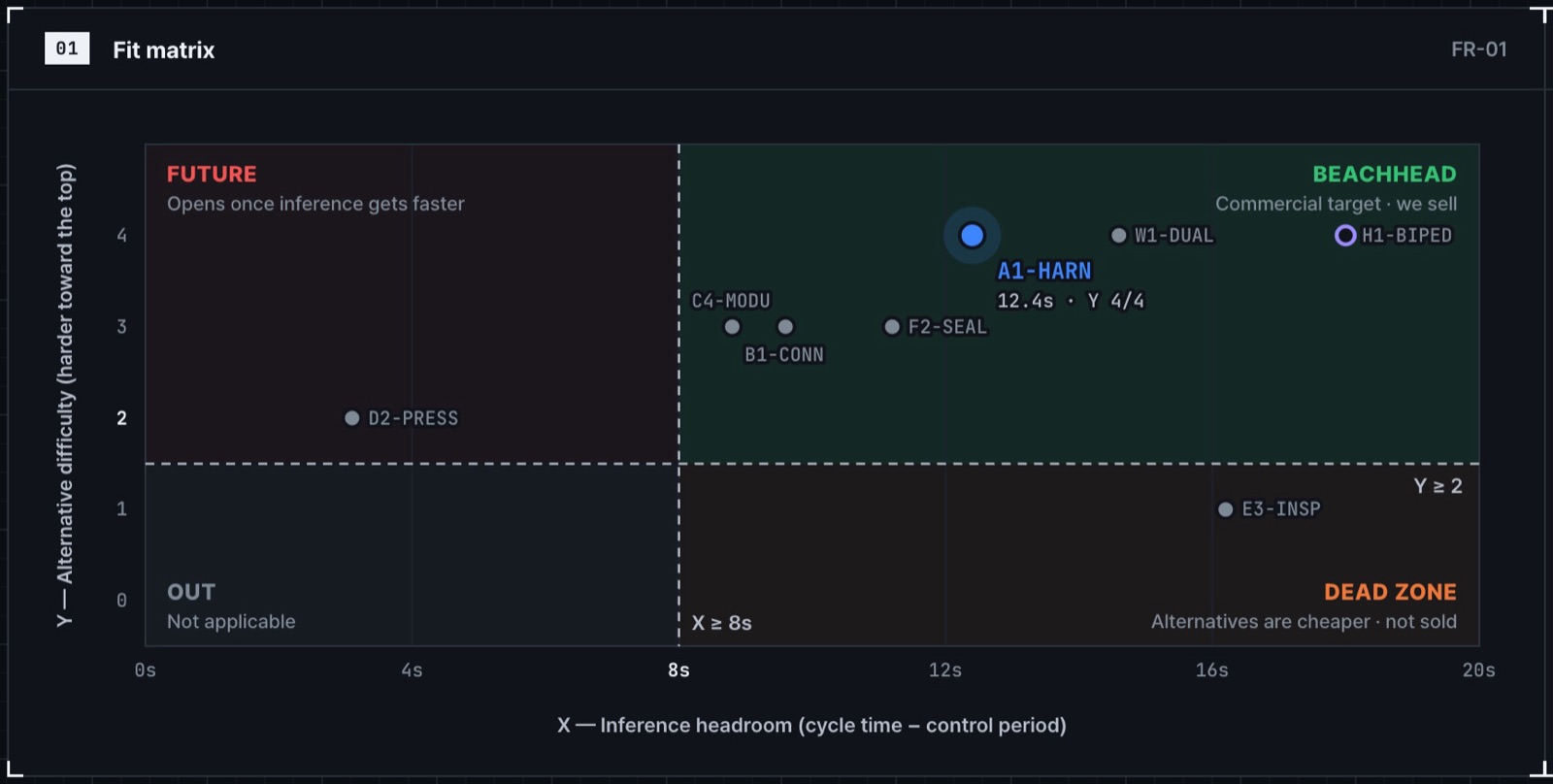
Three axes every cell must pass first. If it doesn't, we say “not now.”
Verdict
§09Company
BlueRoboWorks is part of Axeworks. Axeworks has worked through companies' AX as a matching problem and kept arriving at the same conclusion — matching without data isn't matching, and adoption stalls not on performance but on procedure and approval. BlueRoboWorks brings that method to robots and the floor. We don't compete with integrators — we fit robots on the cells they set up, with that cell's data.
RobotBehavior,Embodied·Rehearsed·Trained
Embodies robot behavior in the cell, rehearses it, and learns on the floor.
§10Contact
Matching takes two sides. We're waiting for sites running contact and deformable assembly cells — and for people who know the robots and standards to fit them.
Other conversations we're open to
Hear re-teaching costs and changeover cycles in the floor's own words.
Interpret together what must be re-verified when a policy changes.